
What Evidence Can Strengthen Your Personal Injury Claim in California?
A personal injury claim is not based only on showing that an accident happened. You generally need evidence connecting another party’s conduct to your injuries and documenting the losses that followed.
Important personal injury evidence may include accident photos and videos, police or incident reports, medical records, witness information, surveillance footage, proof of lost income, receipts, and other records showing how the injury affected you.
The specific evidence needed depends on how the accident happened and what issues are disputed.
What Does Your Evidence Need to Prove?
In a negligence-based California personal injury claim, evidence may be used to establish that another person or business owed a duty of care, breached that duty, caused the injury, and caused compensable damages. Avalon Law’s personal injury page explains these elements in greater detail.
A California personal injury lawyer can also evaluate which evidence may be relevant to the specific facts of a claim.
California Courts advise injured plaintiffs to preserve evidence such as photographs, medical bills or doctor reports, witness statements, and police reports.
Photos and Videos of the Accident and Your Injuries
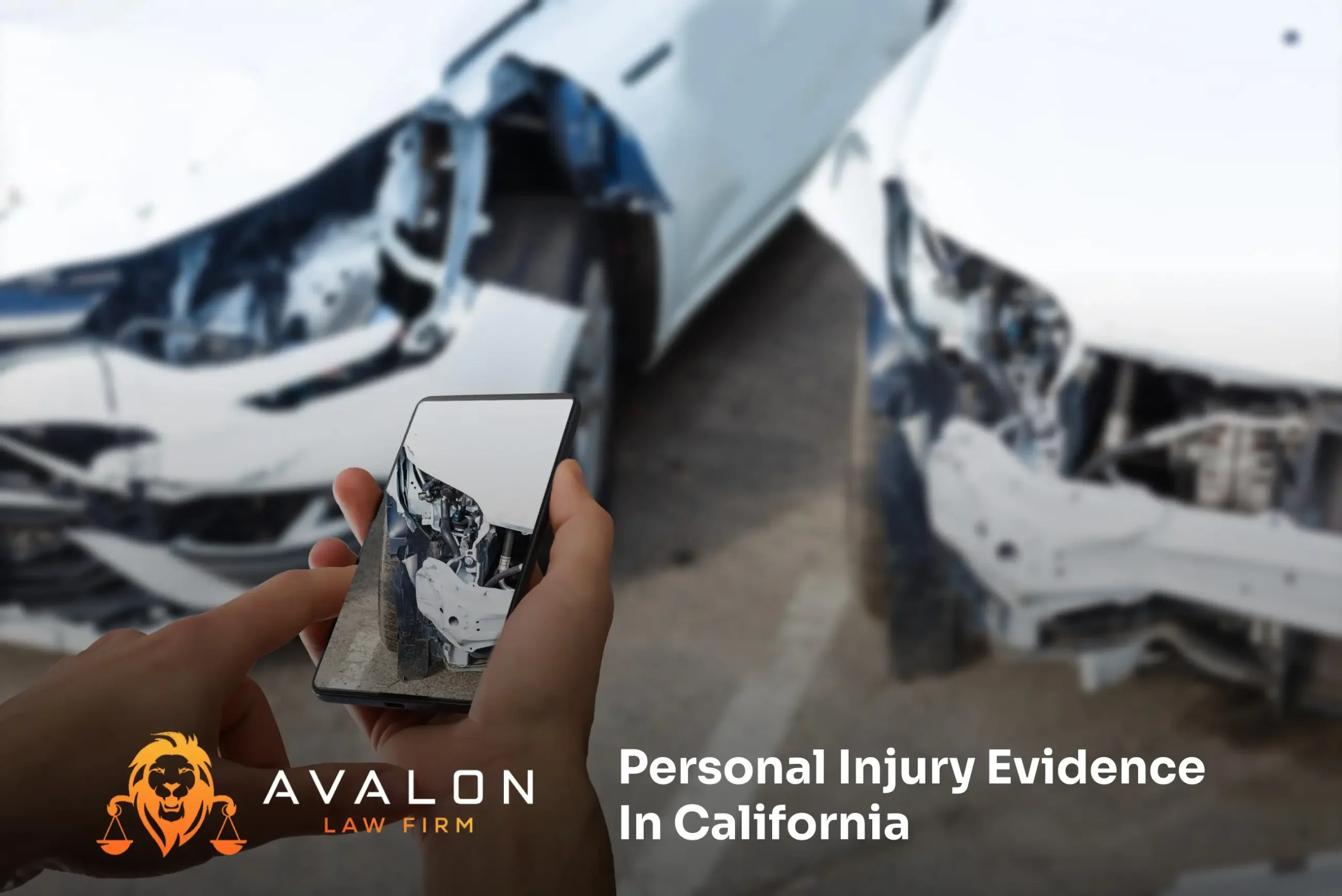
Photos can preserve conditions that may change shortly after an accident.
Depending on the case, useful images may show:
- Vehicle or property damage
- A dangerous condition
- Traffic signs or signals
- Debris or skid marks
- Visible injuries
- The wider accident scene
Videos may provide additional context about the scene or how a hazard appeared.
Police Reports and Incident Reports
A police or CHP report can document information about a traffic collision, including the parties involved, witnesses, vehicles, location, and observations made at the scene.
For an injury at a store, apartment complex, hotel, or other property, a business or property incident report may serve a similar documentation role.
A report does not necessarily resolve every liability issue, but it can provide an important contemporaneous record.
Medical Records, Bills and Treatment History
Medical documentation is often central to proving a personal injury claim.
Relevant records may include:
- Emergency room or urgent-care records
- Physician notes
- Diagnostic imaging
- Prescriptions
- Physical therapy records
- Specialist evaluations
- Medical bills
These documents may help establish what injuries were diagnosed, when symptoms were reported, what treatment was recommended, and the financial cost of that treatment.
California Courts specifically identifies doctors’ reports and medical bills as evidence that can help establish injuries and related losses.
Witnesses, Surveillance and Digital Evidence
An independent witness may be able to describe what happened before or during an accident.
Obtain a witness’s name and contact details whenever possible rather than relying on being able to locate the person later.
Digital evidence can also be important. Depending on the accident, it might include:
- Dashcam footage
- Business surveillance video
- Doorbell-camera footage
- Phone photos or videos
- Relevant electronic or app records
Some evidence may not remain available indefinitely. Recent California competitor content increasingly emphasizes preserving surveillance and other records before they are deleted, overwritten, or lost.
Proof of Lost Income and Other Financial Losses
An injury claim may involve more than medical expenses.
Evidence of financial losses can include:
- Pay stubs
- Employer statements
- Records of missed work
- Receipts
- Transportation expenses
- Prescription costs
- Repair or replacement invoices
California Courts notes that evidence such as a doctor’s work restriction and paycheck records may help document income lost because of an injury.
How Do You Prove Pain and Other Non-Economic Losses?
Not every consequence of an injury comes with a receipt.
Evidence may also help document how an injury affected mobility, sleep, daily activities, hobbies, family responsibilities, or other parts of everyday life.
Medical records, testimony, photographs, and accurate notes about activity limitations may help establish these effects.
The goal should be accurate documentation—not exaggeration.
What Evidence Can Disappear Quickly?
Some of the most important injury claim evidence can change or disappear.
For example:
- Surveillance footage may be overwritten.
- Vehicles may be repaired.
- A dangerous property condition may be corrected.
- Debris may be removed.
- Witnesses may become difficult to locate.
- Electronic records may be deleted under routine retention practices.
This is why evidence preservation should begin as early as reasonably possible.
What If You Did Not Collect Evidence at the Scene?
Failing to take photographs immediately does not necessarily mean no evidence exists.
Depending on the case, evidence may still be available through police or incident reports, medical records, witnesses, surveillance systems, repair records, insurance documentation, business records, or formal discovery if litigation begins.
California Courts explains that civil discovery can be used to request relevant documents and information held by another party.
How Should You Organize Your Personal Injury Evidence?
Keep one organized physical or digital claim file containing:
- Photos and videos
- Reports
- Medical records and bills
- Witness information
- Wage-loss documents
- Receipts
- Insurance correspondence
This information can later help form the foundation of What Goes Into a Personal Injury Settlement Demand Package?
Organization also makes it easier to identify missing records before important evidence becomes harder to obtain.
How Evidence Can Affect the Settlement Process
Insurance companies evaluate claims based in part on the available documentation supporting liability, causation, and damages.
Strong documentation does not guarantee a particular outcome, but incomplete evidence can create disputes about what happened, whether an injury resulted from the accident, or the extent of the losses claimed.
For more on the broader process, see How Long Does a Personal Injury Settlement Take in California?
Conclusion
Building a California personal injury claim requires more than collecting one police report or a stack of medical bills. Different evidence serves different purposes: photos may help establish how an accident happened, medical records document injuries, witnesses provide independent information, and financial records help establish economic losses.
Preserving time-sensitive evidence early and keeping records organized can make the facts easier to evaluate.
Avalon Law Firm represents injured clients throughout California and can review the available evidence, identify additional records that may be relevant, and explain the legal issues involved in a particular claim.
Common Questions About Your Rights
What is the most important evidence in a personal injury claim?
There is no single piece of evidence that is most important in every case. Medical records, photos, reports, witness statements, financial records, and other documentation may each prove different parts of a claim.
Do I need a police report for a personal injury claim?
Not every personal injury case involves a police report. Car crashes may generate police or CHP reports, while injuries on commercial property may instead involve an incident report.
What if I did not take pictures after the accident?
Other evidence may still exist, including witness information, surveillance footage, medical documentation, reports, repair records, and records obtained later through investigation or discovery.
Can surveillance footage help prove an injury claim?
Yes, when relevant footage exists. Video may help show how an accident occurred or what conditions existed at the time. Because some systems overwrite recordings, preservation can be time-sensitive.
How do medical records help a personal injury claim?
Medical records can document when symptoms were reported, diagnoses, treatment, referrals, restrictions, and the progression of an injury.
What evidence can help prove lost wages?
Pay stubs, employer records, doctors’ work restrictions, tax or income documentation where appropriate, and records showing days or hours missed from work may help establish lost income.